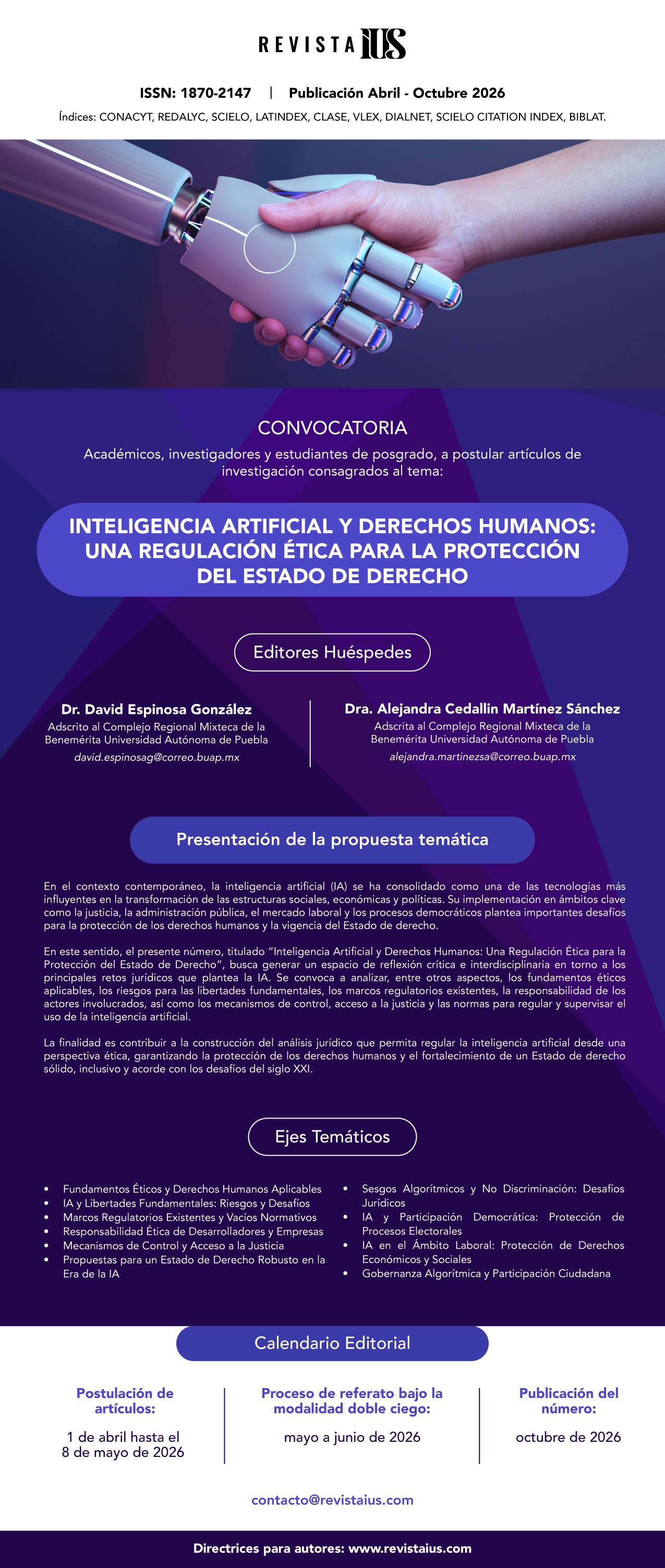
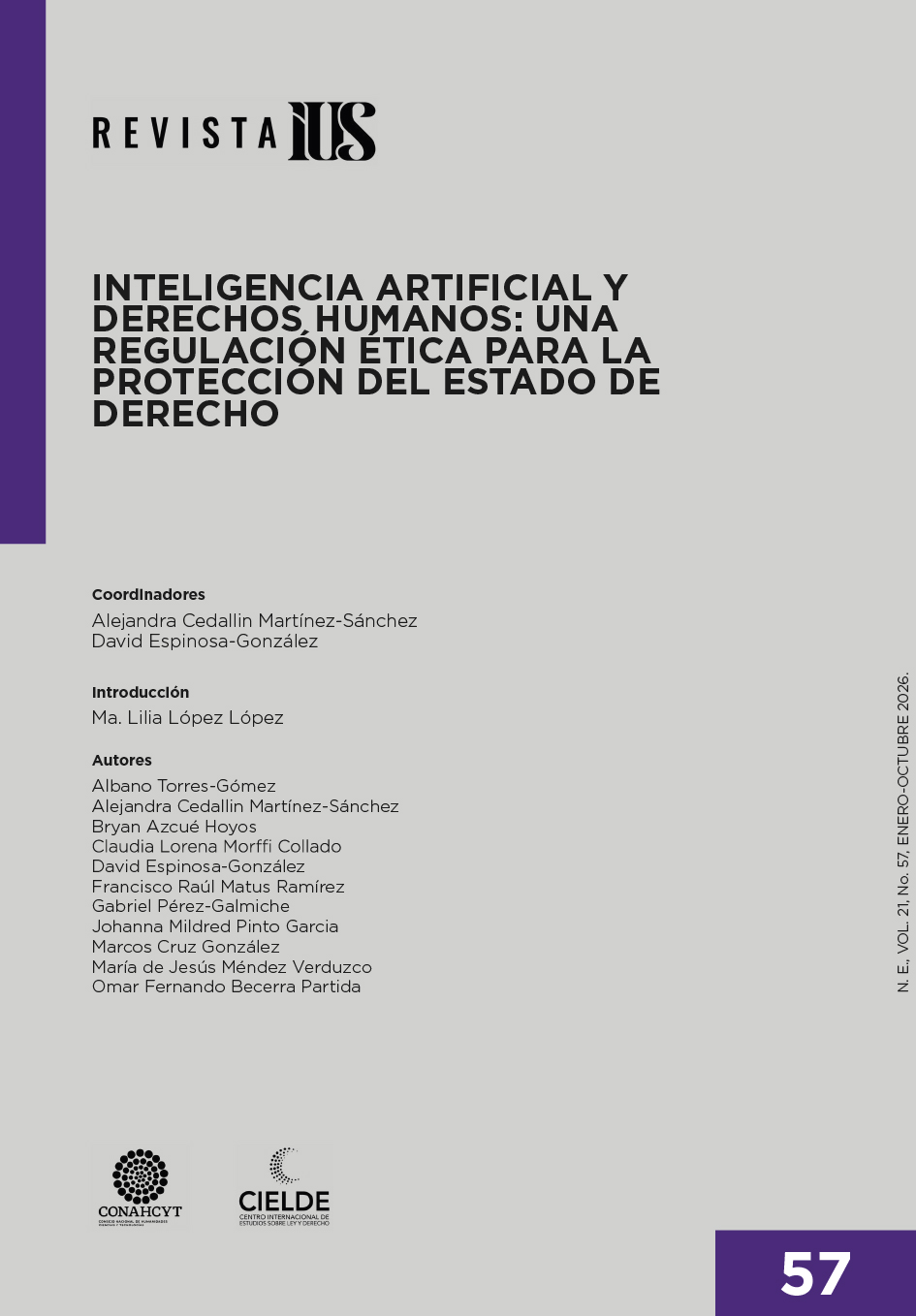
Artificial Intelligence and Human Rights: Ethical Regulation to Protect the Rule of Law

Authors

Abstract

We are pleased to present the new issue of IUS Journal, titled “Artificial Intelligence and Human Rights: Ethical Regulation for the Protection of the Rule of Law”, which addresses the legal, ethical, and social challenges arising from the growing use of artificial intelligence in various spheres of society.

Through a critical and interdisciplinary lens, this issue invites reflection on the need to establish regulatory frameworks that ensure the responsible development and implementation of these technologies, while safeguarding human rights, fundamental freedoms, and the principles of the rule of law.

It also seeks to contribute to the academic debate on the responsibility of the actors involved, oversight mechanisms, and access to justice, promoting a balance between technological innovation, ethics, and the protection of human dignity.

Translated with DeepL.com (free version)

Downloads
Download data is not yet available.

Author Biographies

Albano Torres-Gómez, National Autonomous University of Mexico

He holds a Bachelor’s degree in Computer Systems Engineering from the University of the Americas, Puebla; a Bachelor’s degree in Design and Visual Communication from the National Autonomous University of Mexico; a Master’s degree in Communication from the Benemérita Autonomous University of Puebla; and a Doctorate in Education from the Autonomous University of Tlaxcala. He is currently pursuing a postdoctoral fellowship at the National Autonomous University of Mexico (UNAM).

Alejandra Cedallin Martínez-Sánchez, Benemérita Autonomous University of Puebla

Bachelor’s degree in International Trade and Master’s degree in Higher Education from BUAP. Ph.D. in Education from the Autonomous University of Tlaxcala in Mexico.
As a research professor at BUAP, she has held various positions at the university, including: Curriculum Manager at the DES; Coordinator of the PPC, the LAE, degree programs, and the curriculum proposal for the Master’s in Education at BUAP’s CRM.

Author of indexed and peer-reviewed articles such as “Educational Trajectories in Upper Secondary Education: An Analysis Based on Academic Factors,” as well as scientific works such as “Educational Trajectories from the Perspective of Transversal and Differential Factors”; “An Investigative Study of Women Researchers’ Trajectories in the Mixteca Region of Puebla (Atlixco, Puebla)”; “Educational Trajectories in Tertiary Education: An Analysis of Their Factors”; and she has coordinated collaborative works such as “Education, Law, Economy, and Society.”

Finally, she is the author of two books titled: “Educational Research in the Social, Legal, and Economic Context: The Higher Education Landscape in Light of Liquid Education from the Faculty Perspective at the BUAP’s CRM” and “Educational Trajectories from the Perspective of Transversal and Differential Factors: The Case of the Bachelor’s Degrees in Business Administration and Biotechnology at the BUAP’s CRM.”

Bryan Azcue Hoyos, Mixteca Regional Campus of the Benemérita Autonomous University of Puebla

He holds a bachelor’s degree in Gastronomy, a master’s degree in Administration, and is pursuing a doctorate in education. He has international certifications in food safety from ServSafe. From an early age, he has shown a deep interest in research areas related to educational administration, food safety, and, more recently, adapting to the new norms brought about by artificial intelligence in various contexts. He currently serves as an adjunct instructor and coordinator of the Gastronomy Laboratory at the Mixteca Regional Campus of the Benemerita Universidad Autónoma de Puebla, where he promotes the comprehensive education of students through an interdisciplinary approach. He is the author of a chapter in the digital publication *Educational and Legal Issues and Phenomena: Between Pending Matters and the Challenges of Mexican Regionalism*. In addition, he actively participates in cultural, scientific, and educational events organized by national universities and agencies of the Government of Mexico.

Claudia Lorena Morffi Collado, Investigador posdoctoral

Ph.D. in Legal and Political Sciences from Pablo de Olavide University, Seville, Spain; awarded Cum Laude by unanimous decision. Trained as a data protection officer at the Catholic University of Murcia. Master’s degree in Higher Education Sciences. Author and co-author of various books and scholarly articles specializing in law. Her research focuses on the intersection of human rights and biolaw, as well as on the legal analysis of contract termination and the legal challenges posed by artificial intelligence in public administration.

David Espinosa – González, Benemérita Autonomous University of Puebla

Lawyer, Notary Public, and Actuary from BUAP, with advanced studies at the University of Lleida (Catalonia, Spain). Graduated with honors from his graduate studies in law at BUAP: Master’s in Law with a specialization in Constitutional Law and Amparo, and doctorates in Law and Education. Expert in Parliamentary Law from UNAM.

Member of the academic body “MULTIDISCIPLINARY STUDIES OF THE MIXTECA REGION: EDUCATIONAL, LEGAL, AND SOCIAL” at the BUAP Mixteca Regional Complex (CRM-BUAP); he meets the PRODEP-SEP and VIEP-BUAP “Desirable Profile” criteria and serves as a research professor at CRM-BUAP. Founder of the Regional Complexes Repository, as well as various research centers and departments at institutions and universities in the state of Puebla. Founder of the “CRM-BUAP Researcher Training” project.

He is the author of articles in peer-reviewed and indexed journals such as *Teuken Bidkay* and “Michel Foucault and His Discourse Beyond the Philosophical” in the *International Humanities Review – Global Knowledge*; he has authored books published by publishers such as Tirant lo Blanch, Dykinson, and Thompson Reuters; and he has served as editor for works published by Editorial Montiel y Soriano.

Francisco Raúl Matus Ramírez, Faculty of Law and Social Sciences at the Michoacana University of San Nicolás de Hidalgo and the Division of Graduate Studies within the same faculty

Ph.D. candidate in Philosophy at the Institute for Philosophical Research at UMSNH; Master’s degree in Constitutional Procedural Law and Bachelor of Laws, both from the Universidad Michoacana de San Nicolás de Hidalgo. Professor in the School of Law and Social Sciences at UMSNH and in the Division of Graduate Studies at the same institution. Member of the Michoacán Registry of Researchers 2026. His most recent publications are: Article: “The Foundations of Human Rights Based on Ethical Intentionality in Paul Ricoeur,” published in IusInkarri, Vol. 14, No. 18, Lima, Peru, DOI: 10.59885/iusinkarri.2025.v14n18.04; “Dworkin’s Methodology: Iusmoralism and Progressive Liberalism,” published in Pensamiento Jurídico, Bogotá, 2025, DOI: https://doi.org/10.15446/peju; “The Sense of Justice and Rights: Perspectives from Alfonso Villa,” published in Derecho global. Studies on Law and Justice, Year 2026, DOI: https://DOI.org/10.32870/dgedj.v11i32.881.

Gabriel Pérez - Galmiche, Benemérita Autonomous University of Puebla

He earned a bachelor’s degree in economics, a master’s degree in business administration, and a doctorate in law from the Benemérita Universidad Autónoma de Puebla; his postdoctoral studies in the research area of “Public Policy” were accredited by the University of Alcalá de Henares in Spain.

He is a tenured research professor at the Benemérita Universidad Autónoma de Puebla.

He has held leadership positions at BUAP, including Director of Liaison and Governance in the General Secretariat, Director of Student Integration Development, Director of Student Services, Director of the Mixteca Regional Complex, and Director General of Archives.

He is a member of the National System of Researchers (SNII Level 1) and an evaluator for CONAHCYT.

Author of books and articles with national and international reach, such as: “E-commerce,” “Comparative Analysis of the Legal Framework for Advance Directives in Mexico and Spain,” and editor of collective works such as “Respect for Fundamental Rights in Mexico,” “Education, Law, Economy, and Society,” and “Exploring Horizons.”

Speaker at national and international events.

Johanna Mildred Pinto García, National Autonomous University of Mexico

She holds a Bachelor of Laws degree from the Nueva Granada Military University and a specialization in Public Law from the Externado University of Colombia. She is currently pursuing a Master of Laws degree, with a focus on the Philosophy of Law, at the National Autonomous University of Mexico (UNAM). Her research interests center on legal philosophy and theory, comparative constitutional law, and the legal regulation of digital technologies and artificial intelligence. She has published articles in peer-reviewed academic journals, including “The Limits of Digital Constitutionalism: Asymmetries of Algorithmic Power and the Need for Structural Reorganization” (Revista Jurídica, Autonomous University of Guerrero) and “Integration of Artificial Intelligence in Constitutional Democracies: Conceptual Challenges and Regulatory Proposals” (De Jure, University of Colima). She has presented at more than twelve international conferences in Mexico, Colombia, and Chile, and serves as a peer reviewer for indexed journals such as *Derecho del Estado* (Externado University of Colombia) and *Postulados* (UFPS).

She is a collaborator on the research project on Technology Companies, Digital Platforms, and Economic, Social, and Cultural Rights (ESCR), developed in partnership between UNAM, Boston College, and UCAB, within the framework of the Special Rapporteur on ESCR.

Marcos Cruz González, Mixteca Regional Campus, Benemérita Autonomous University of Puebla

2021–2026 Faculty Member and Researcher at the Mixteca Regional Campus of the BUAP. Member of the National System of Researchers, Level 1. 2018–2020 Postdoctoral Fellowship at the Autonomous University of the State of Morelos (UAEM). 2013–2017 Doctor of Law degree from the Graduate School of Law at the Benemérita Autonomous University of Puebla. 2010–2012 Master’s Degree in Civil and Commercial Law from the Graduate School of Law at the Benemérita Autonomous University of Puebla. 2004–2009 Degree as Attorney, Notary Public, and Actuary awarded by the School of Law at the Benemérita Autonomous University of Puebla. Author and co-author of several books and scholarly articles in the field of law, on topics such as: the Legal and Economic Impact of the USMCA; Human Rights; Unnamed Fundamental Rights; Bioethics; the Right to Attempt Experimental Treatments (Right to Try); Advance Directives; Organ Donation through Presumed Consent; the UN’s credibility crisis; and human rights and the regulation of artificial intelligence in Mexico.

María de Jesús Méndez Verduzco, University Center for Health Sciences, University of Guadalajara

Master’s degree in Ethics and Ph.D. in Bioethics and Human Rights from the Jalisco Institute of Ethics and Therapy. Bachelor’s degree in Nutrition from the University of the Valley of Atemajac. Adjunct professor in the Department of Morphology at the University Center for Health Sciences of the University of Guadalajara. She is a trainer of bioethics instructors for UNESCO and a founding member of the Jalisco College of Bioethics and Therapy, A.C.

Omar Fernando Becerra Partida, University Center for Health Sciences, University of Guadalajara

Ph.D. in Bioethics and Human Rights from the Jalisco College of Bioethics and Therapy, A.C.; Master’s degree in Corporate Law, Ethics, Bioethics, and Law; law degree from the University of Guadalajara with a specialization in Bioethics. President of the Jalisco College of Bioethics and Therapy, A.C.; trainer of bioethics instructors for the National Autonomous University of Mexico and UNESCO. Adjunct professor in the Department of Social Sciences at the University of Guadalajara. Journalist and author of publications indexed nationally and internationally.

Published

2026-10-14

Most read articles by the same author(s)

1 2 > >>