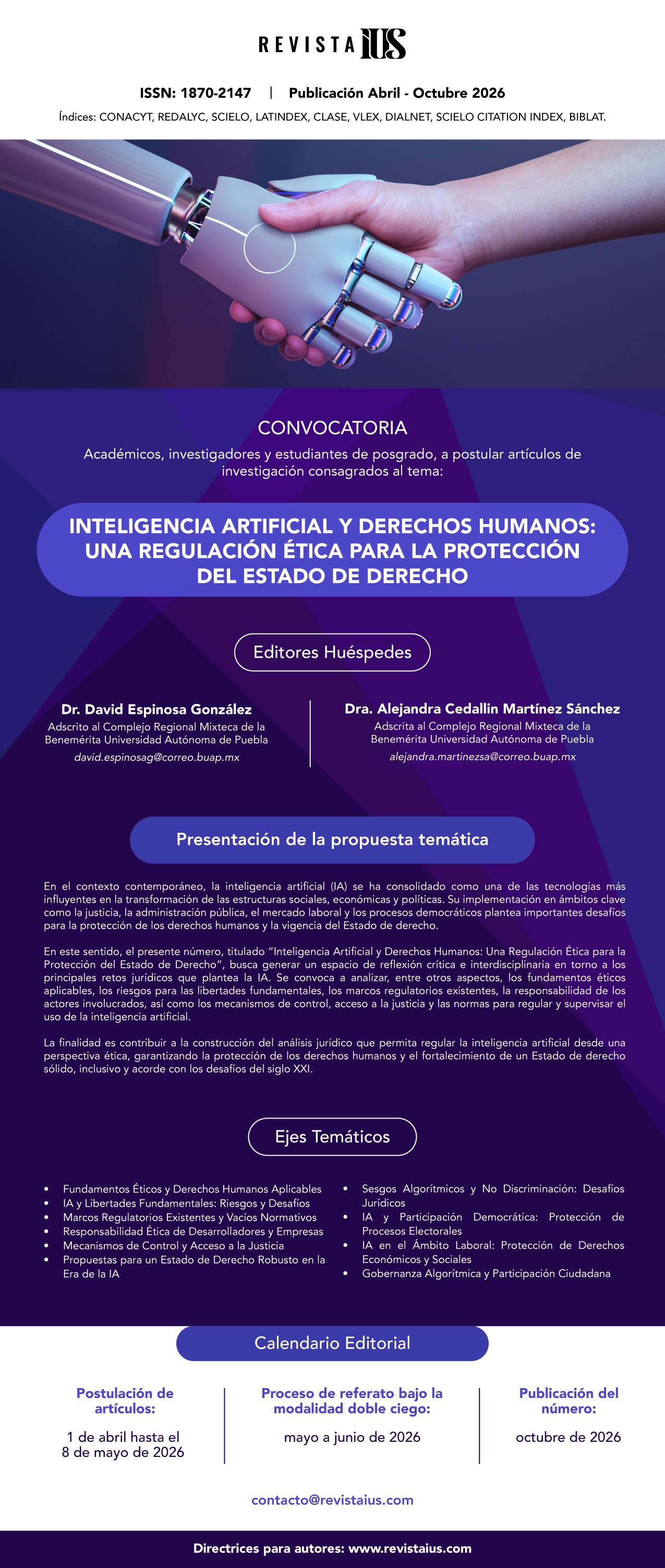
The right to educate and to be educated: limits and ten- sions between religious freedom and sex education in the Colombian state
Abstract
This article analyzes the limits and scope of parents’ right to choose their children’s religious education in Colombia, especially when it conflicts with mandatory sex edu- cation curriculum content. Based on normative, doctrinal, and jurisprudential study, it examines how religious freedom and the right to education interact in a constitutional and international context that recognizes the primacy of the family’s formative role. There is evidence of growing state intervention which, by imposing ideological guidelines on sex education, may violate fundamental rights and restrict cultural and religious diversity. The paper concludes that the state must act in a subsidiary and neutral manner, guaranteeing an education that respects family beliefs, promoting alternatives, and avoiding ideological uniformity among minors. Only in this way is it possible to harmonize sex education with religious freedom in a truly pluralistic environment.
Downloads
Downloads
Published
Issue
Section
License

This work is licensed under a Creative Commons Attribution-NonCommercial-ShareAlike 4.0 International License.
Revista IUS, published by the Legal Sciences Institute of Puebla A.C., is distributed under the Creative Commons Attribution-NonCommercial 4.0 International (CC BY-NC 4.0) license.
We authorize collaborators to upload a copy of their published work on their personal websites or any Open Access repository, provided that Revista IUS is specifically cited as the original source, indicating the year and issue of the respective example and adding the link to the webpage on which this publication can be freely consulted in toto and without charge: http://www.revistaius.com
Readers are free to:
Share, copy and redistribute the material via any medium or format.
The licensor cannot revoke these freedoms as long as you follow the license terms.
Under the following terms:
Attribution: You must give appropriate credit, provide a link to the license, and indicate if changes were made.
You may do so in any reasonable manner, but not in any way that suggests the licensor endorses you or your use.
NonCommercial – You may not use the material for commercial purposes.
If you remix, transform or build upon the licensed material, its distribution is not permitted.
Charges for managing articles: Revista IUS will not charge for receiving, processing or publishing articles (Article Processing Charge, or APC) submitted by authors.